

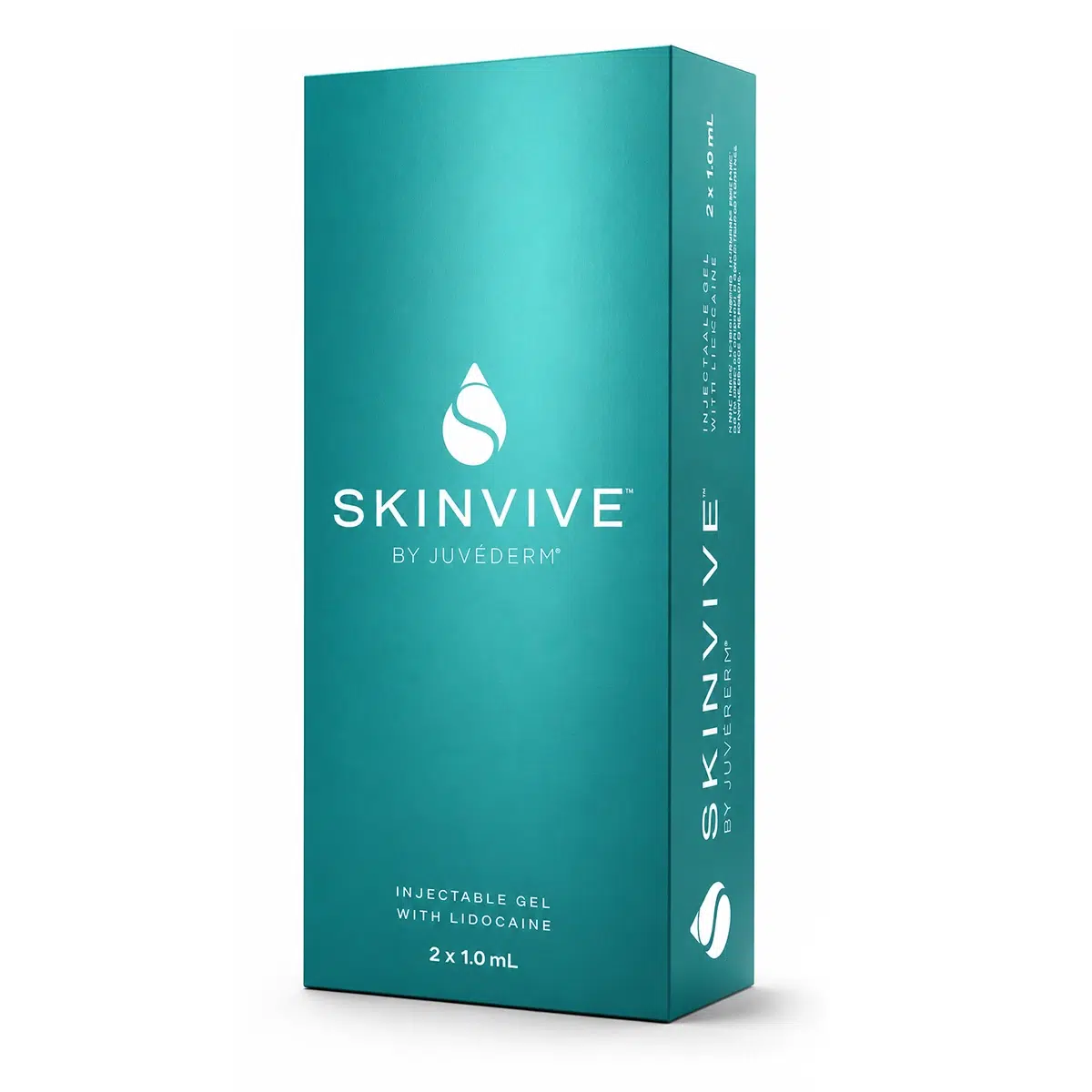
$309.00
Manufacturer: Allergan
Active Substance(s): HYALURONIC ACID (HA), LIDOCAINE
Strength: 12mg/ml
Pack Size: 2 x 1ml pre-filled syringe(s) + 4 needles 32G-1/2″
Juvederm® Skinvive — Intradermal Hyaluronic Acid for Cheek Skin Smoothness & Facial Hydration
Most dermal filler injection protocols address volume loss or structural contouring, yet declining intradermal hydration is a separate clinical concern that volumizing fillers are not designed to treat. Juvederm® Skinvive is the first FDA-approved hyaluronic acid gel implant specifically indicated to improve skin smoothness of the cheeks in adults over 21. Practitioners looking to buy Juvederm® Skinvive can contact the Medica Depot team for availability and supply information.
Product Specifications
Active ingredient: Hyaluronic acid (HA) — cross-linked microdroplet formulation (VYC-12L; 12 mg/mL HA + 0.3% lidocaine)
Product type: Injectable gel implant; intradermal delivery
Manufacturer: Allergan Aesthetics (AbbVie)
Regulatory status: FDA-approved (2023) — first and only HA gel implant approved for cheek skin smoothness
Indication: Improvement of skin smoothness of the cheeks in adults over 21
Storage: 2–25°C; protect from freezing and direct sunlight
Intended use: Licensed aesthetic medicine practitioners only
What Is Juvederm® Skinvive?
Juvederm® Skinvive is an injectable hyaluronic acid gel implant. It is the first and only product to receive FDA approval (2023) for improving skin smoothness of the cheeks in adults aged 21 and older. Manufactured by Allergan Aesthetics (AbbVie), it is classified as a prescription device restricted to licensed aesthetic medicine practitioners.
Unlike traditional volumizing dermal fillers, Skinvive targets intradermal hydration and skin quality rather than structural correction. The FDA designation “gel implant” reflects the product’s injectable regulatory classification; it is not a prosthetic device.
In CE-marked markets, the same VYC-12L formulation is available as Juvederm® Volite, with indication scope varying by region. Practitioners should verify local prescribing information and current regulatory status before use. (Regulatory information current as of May 2026.)
Key Characteristics of Juvederm® Skinvive: Achieving Cheek Smoothness
Skinvive occupies a distinct position within the injectable aesthetic category. Its key differentiators include:
Indication-specific approval: The only FDA-approved product indicated for improving cheek skin smoothness; not a repurposed volumizing filler
Microdroplet delivery system: Small-volume HA deposits are distributed diffusely across the cheek dermis, supporting uniform hydration rather than focal tissue expansion
Cross-linked HA matrix: Provides structural resistance to enzymatic degradation, extending duration beyond non-cross-linked HA solutions
Hydration-only mechanism: No volumizing or contouring effect. Clinical outcomes are limited to improved skin smoothness, radiance, and facial tissue hydration
Lidocaine-enhanced formulation: The 0.3% lidocaine component supports patient comfort during administration
Patient selection is an important clinical consideration. Candidates presenting with dull skin texture or loss of facial smoothness (without significant volume loss) represent the appropriate profile for Skinvive treatment. The product does not replace volumizing or contouring protocols; it complements them.
How Juvederm® Skinvive Works
Juvederm® Skinvive works by delivering cross-linked hyaluronic acid into the dermis, where HA molecules attract and retain water within the extracellular matrix — restoring dermal hydration and improving cheek skin texture at the tissue level. The microdroplet technique places small, evenly distributed deposits throughout the cheek dermis, hydrating facial tissue diffusely rather than creating focal projection or contour change.
Cross-linking extends the degradation time of the HA matrix, maintaining the hydration effect longer than non-cross-linked HA solutions. Clinical outcomes are associated with improved face smoothness and skin quality, not structural augmentation.
Clinical Applications & Outcomes
US Pivotal Study
In a randomized, evaluator-blind, controlled trial, Skinvive™ by Juvederm® significantly improved cheek skin smoothness. At one month, 57.9% of treated patients were responders on the Allergan Cheek Smoothness Scale (ACSS), compared to 4.5% in controls (p < 0.001), with results maintained at six months (55.6%). Among patients who received repeat treatment at six months, responder rates reached 68.5% at one month post-repeat and 65.7% at four months.
Patient-reported outcomes showed meaningful improvements in skin quality. FACE-Q Satisfaction with Skin scores increased from 34.9 at baseline to 66.8 at one month and 60.2 at six months. Satisfaction with skin hydration rose from 23.7% to 78.4%, and radiance from 11.1% to 74.4% at one month.
European Clinical Study
A prospective study in France (n = 131) evaluating Skinvive® (without lidocaine) across the cheeks, forehead, and neck reported a 96.2% ACSS responder rate at one month, with 76.3% maintaining improvement at four months. Hydration benefits were observed for up to 9 months, supporting the longer durability observed internationally under the Juvederm® Volite designation.
Clinical Interpretation
Across studies, outcomes consistently show improved skin smoothness, hydration, and radiance, without changes in facial volume or contour. Treatment expectations and maintenance should align with region-specific labeling and guidance.
Administration & Safety Considerations
Administration: Juvederm® Skinvive injection is administered using the intradermal microdroplet technique across the cheek region by a trained aesthetic practitioner. Precise injection depth and even distribution across the treatment area are important for achieving uniform hydration outcomes. Sessions are typically repeated at 6-month intervals.
Common side effects: Adverse effects are consistent with the hyaluronic acid filler class: swelling, bruising, erythema, tenderness, and injection-site discomfort. These reactions are generally mild and transient.
Serious risks and contraindications: Rare but serious complications include vascular occlusion, delayed inflammatory reactions, and hypersensitivity events. Standard HA complication management protocols — including access to hyaluronidase — should be in place during treatment. Contraindications include hypersensitivity to hyaluronic acid or lidocaine and active infection or inflammation at the treatment site.
Citations
Alexiades M, Palm MD, Kaufman-Janette J, et al. A randomized, multicenter, evaluator-blind study to evaluate the safety and effectiveness of VYC-12L treatment for skin quality improvements. Dermatol Surg. 2023;49(7):682-688. doi:10.1097/DSS.0000000000003802
Chiu A, Montes JR, Munavalli G, et al. Improved patient satisfaction with skin after treatment of cheek skin roughness and fine lines with VYC-12L: participant-reported outcomes from a prospective, randomized study. Aesthet Surg J. 2023;43(11):1367-1375. doi:10.1093/asj/sjad111
Kablik J, Monheit GD, Yu L, Chang G, Gershkovich J. Comparative physical properties of hyaluronic acid dermal fillers. Dermatol Surg. 2009;35(Suppl 1):302-312. doi:10.1111/j.1524-4725.2008.01046.x
Premarket Approval (PMA) P110033S059. US Food and Drug Administration. https://www.accessdata.fda.gov/cdrh_docs/pdf11/P110033S059C.pdf. Published 2023.
For licensed medical professionals only. This content is for informational purposes only and does not constitute medical advice.
Related products